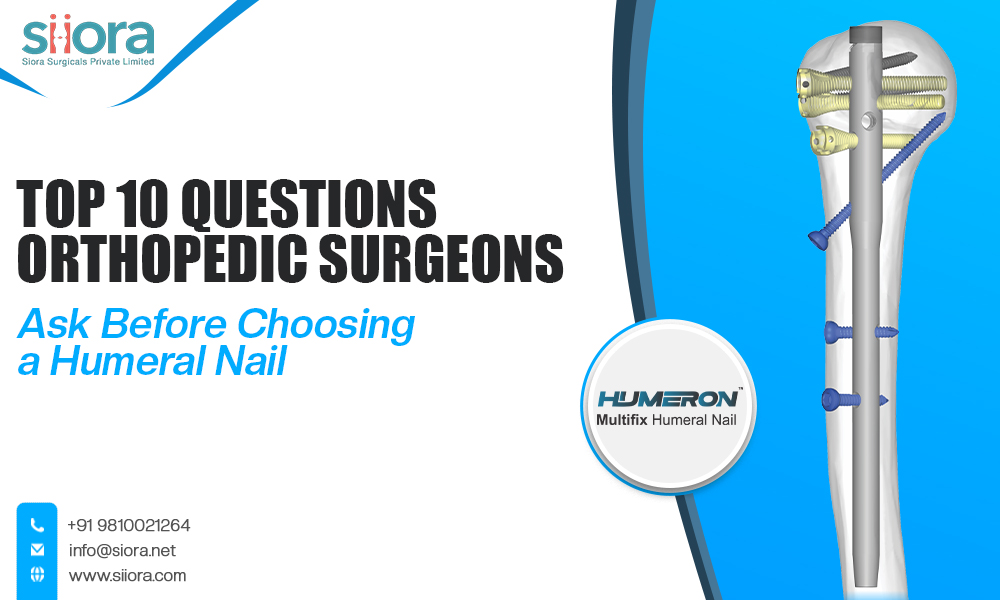
Picking the right humeral nail can make or break a proximal humerus fracture fix—surgeons want stability without turning a two-hour op into a nightmare. These intramedullary rods slide down the humerus canal to lock fragments in place, but not all nails are created equal. Here’s the top 10 questions docs grill reps about, boiled down from real OR chats and case reviews.
- What’s the Nail Diameter Range?
Humerus canals vary widely, especially in osteoporosis cases. Surgeons need options from 8mm to 14mm to avoid over-reaming or loose fits that lead to rotation. Too skinny, and it spins; too fat, and you split the cortex. Most ask for modular sets covering ±1mm increments for quick swaps mid-case.
- How Many Proximal Locking Options?
Proximal screws are king for head and tuberosity control. Top nails offer 4-6 holes with multi-directional or calcar-centric designs to grab those pesky greater/lesser tuberosities. Surgeons hate missing options in three- or four-part fractures—calcar screws cut subsidence risks by half.
- Distal Locking: Static or Dynamic?
Distal screws prevent shortening, but dynamic slots allow some compression for better unions. Docs quiz on how many static holes (at least two) versus dynamic ones, plus ease of insertion through small incisions. In shaft extensions, this keeps everything aligned without endless fluoroscopy.
- What’s the Entry Point Design?
Straight nails risk rotator cuff tears; curved or offset ones hug the anatomy better. Surgeons push for posterior or lateral entry with a small footprint—under 10mm—to spare deltoid splits and supraspinatus. Nail-in-nail systems with fins or blades score points for rheumatoid or revision cases.
- Material: Titanium or Stainless?
Titanium is lighter, MRI-friendly, and fatigue-resistant, but stainless steel holds up in high-load athletes. Questions zero in on modulus of elasticity matching bone to cut stress shielding, plus corrosion data. Most lean titanium for elderly patients where weight matters.
- Length Options for Shaft Coverage?
Short nails (15-20cm) suit isolated head fractures; longer ones (25-30cm) handle segmental breaks. Surgeons ask about incremental lengths (2cm steps) and how they bypass distal hardware from prior elbow fixes. Custom extensions? A bonus for obese arms.
- Reaming System: Flexible or Rigid?
Flexible reamers glide through bowed humeri without binding; rigid ones are faster for straight shots. Docs want disposable bits, depth gauges matching nail lengths, and guides that don’t wander. Over-reaming by 1mm is standard to ease insertion without chatter.
- Biomechanical Data on Load to Failure?
No surgeon buys on faith—pullout strength, torsional stability, and fatigue testing under cyclic loads (like 2 million cycles) get grilled. Comparisons to competitors’ plates or older nails seal deals, especially for varus collapse prevention in osteopenic bone.
- Surgical Time and Learning Curve?
Nails should clock under 60 minutes versus 90 for plates. Questions hit jig stability, one-shot targeting arms, and fluoroscopy needs. Reps demo on cadavers; surgeons want stats showing 20-case mastery for residents.
- Complication Rates and Revision Ease?
Union rates over 95%, infection under 2%, and orthopedic implant removal below 5%? Yes please. Doctors probe real-world registries for cutout, nonunion, or nerve issues, plus modularity for revisions—like swapping proximal segments without full extraction. Cost-effectiveness ties it up, balancing upfront price against fewer reops.
Choosing a humeral nail boils down to matching patient fractures with reliable, surgeon-friendly tech. Top brands shine by answering these head-on with data, demos, and support. In busy trauma centers, the right pick means patients swinging arms by three months, not wrestling slings forever.
 Siora Surgicals Pvt. Ltd.